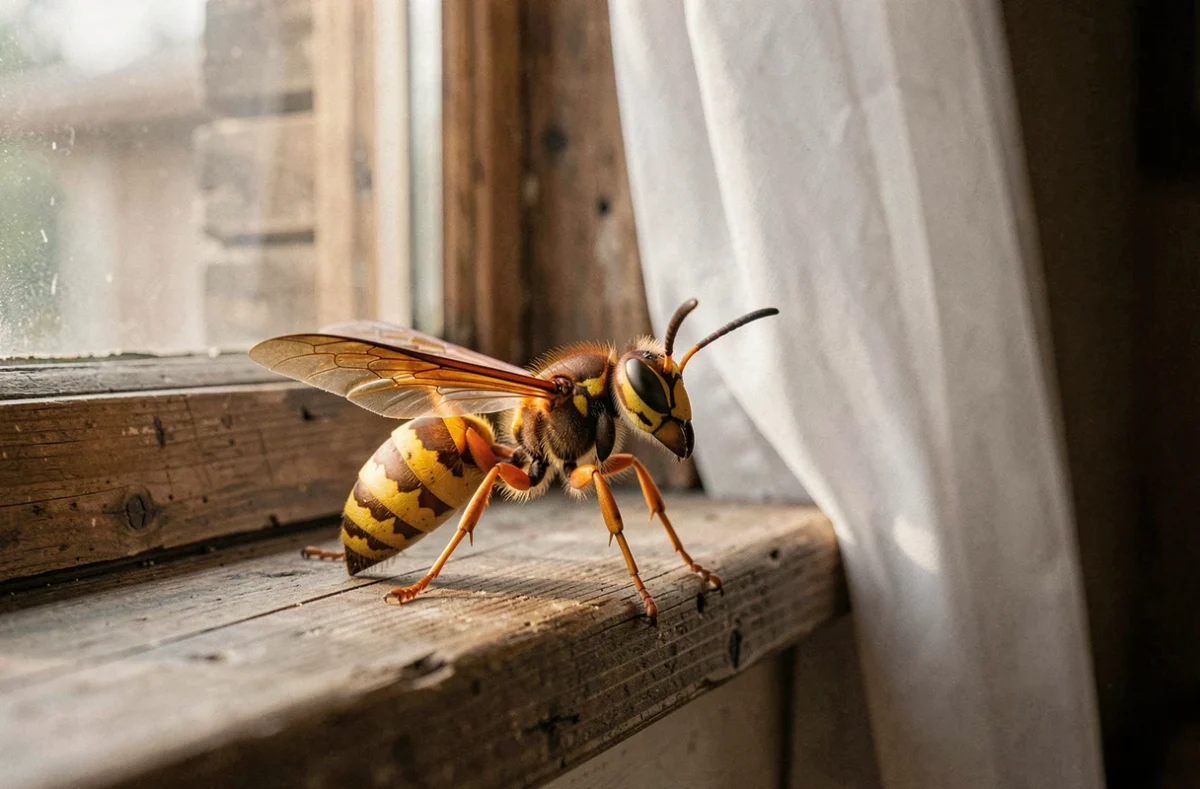
An Asian hornet entering a home can be understood in two distinct ways: through entomological behavior (a lost individual or one scouting for a nest site) and through the symbolism associated with social wasps. Conflating the two leads to a less nuanced analysis. The following brings them together without confusing them.
Asian hornet and European hornet: different symbolism
Most articles on the spiritual meaning of hornets treat the genus Vespa as a single, uniform group. The Asian hornet (Vespa velutina) is not the European hornet (Vespa crabro), and this distinction changes the symbolic interpretation.
The European hornet has long been established in the region and has been part of rural folklore for centuries. It embodies guardianship, the defense of the threshold, and the solitary strength of a watchful sentinel. The Asian hornet, by contrast, is an invasive species that arrived in France relatively recently, associated with predation on honeybee colonies and disruption of local ecosystems.
Symbolically, its non-native origins give its presence a different meaning: that of intrusion, of an outside force destabilizing an established system. When it enters a home, we can read it as a mirror of something in our inner lives that acts as an unidentified disruptive element—an emotion, relationship, or situation that has taken hold without being invited.
Several traditions associated with social insects distinguish between an expected visitor and an intruder. An Asian hornet in the home does not carry the same message as a bee or a European hornet, because its very nature speaks of invasion and forced adaptation.
Spiritual symbolism of a hornet in the home: beyond omens
Reducing the spiritual meaning of an Asian hornet in the home to a positive or negative omen oversimplifies a complex signal. The most coherent interpretation brings together three themes.
Territoriality and personal boundaries
The hornet is a deeply territorial animal. Its colony defends a specific area, and any individual that crosses into it triggers a response. In symbolic terms, its presence calls the strength of your own boundaries into question. A hornet entering your home may reflect an area of your life where boundaries have become porous: excessive tolerance, difficulty saying no, or neglect of your personal space.
Warning and vigilance
In Native American traditions, the hornet is associated with protection and alertness. Its painful sting is not without cause: it punishes an encroachment on its territory. Spiritually, this warning can be understood as a call to stay vigilant. The message does not necessarily concern physical danger, but rather a latent conflict that needs your attention before it erupts.
Transformation and the cycle of renewal
The Asian hornet’s life cycle sheds light on this aspect. Each year, the colony dies. Only the future queens survive the winter to establish a new nest in spring. An abandoned nest is never reused. This pattern of destruction and rebuilding carries a symbolism of radical transformation: what has been built can collapse without that necessarily meaning failure, since renewal follows.
A lone hornet or repeated visits: interpreting the circumstances
The symbolic meaning varies according to the specific circumstances of the encounter. A lone individual in a room does not send the same signal as repeated visits to a fixed spot in the home.
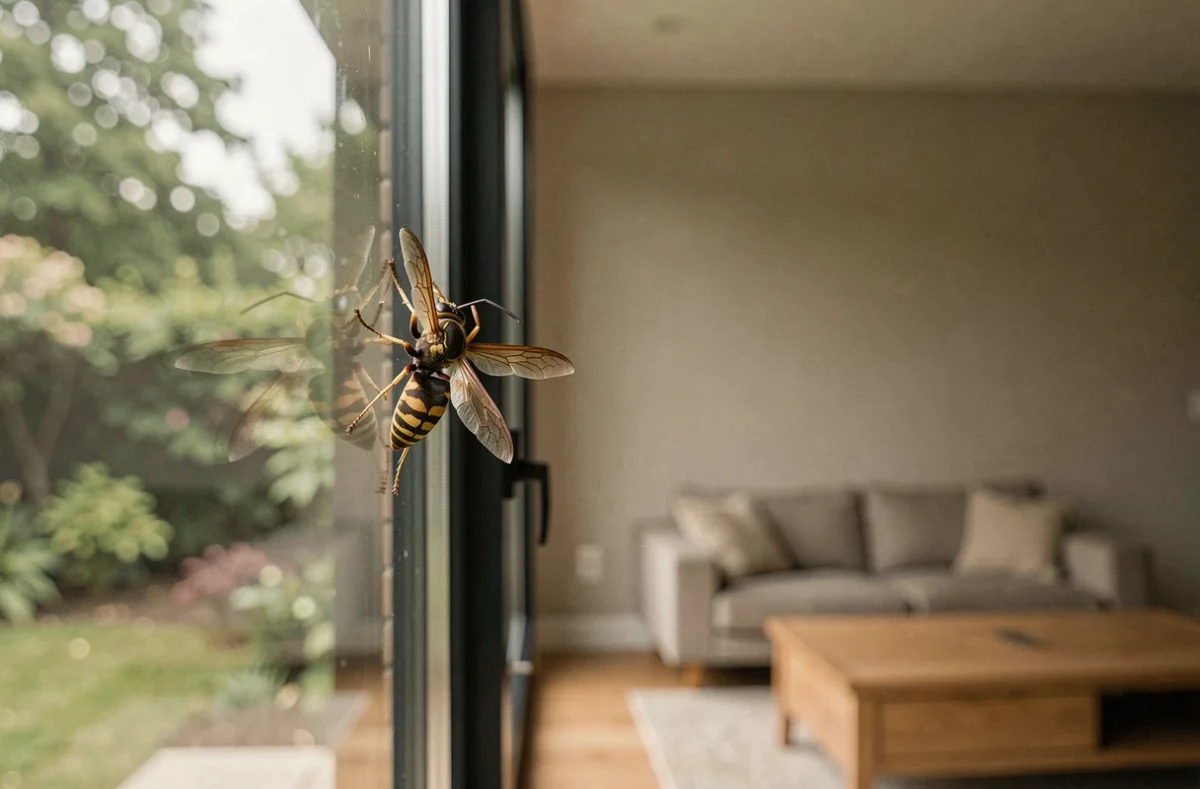
- A single, disoriented hornet bumping into windows suggests a passing message: a brief warning, or a reminder about a specific issue you tend to avoid.
- Regular visits to the attic or eaves indicate that a nest may be forming (a primary nest in spring, a secondary nest in summer). Symbolically, this points to a recurring pattern, a dynamic taking root in your daily life that urgently needs examining.
- Finding a dead hornet indoors marks the end of a cycle. Several traditions see this as the close of a difficult period, the resolution of a conflict, or a fear losing its hold.
The season matters, too. An old nest visible in winter is unoccupied: the queens have left to overwinter elsewhere. Finding this empty structure may symbolize a resolved problem of which only a physical trace remains—an invitation not to revive what is already over.

Asian hornet sting: the spiritual meaning of direct contact
A sting is the most intense form of interaction with this insect. Spiritually, it amplifies the warning. Where mere presence suggests, a sting makes the message impossible to ignore.
Several interpretations converge on one point: physical pain reflects a refusal to heed a subtler signal. The hornet first warned you through its presence, its buzzing, and its flight around you. The sting comes when the transgression—symbolic or territorial—continues.
In practical terms, this may point to a situation in which you have long ignored a relationship imbalance, a toxic environment, or a repressed personal need. The sting is not a punishment, but a final warning before the consequences become entrenched.
Distinguishing symbolic interpretation from entomological reality
An Asian hornet in the home is first and foremost an insect whose repeated presence may indicate a nearby nest. French regulations have also recently changed regarding the collective management of this invasive species, which poses a direct threat to bee populations.
Embracing the symbolic dimension does not mean abandoning caution: near an active nest, physical safety takes precedence over any spiritual interpretation. Calling a professional to deal with an identified nest does not negate the message you have received. On the contrary, it shows an ability to act on what threatens your space—which is precisely at the heart of the symbol.
An Asian hornet in the home speaks of crossed boundaries, neglected vigilance, and cycles in need of renewal. Whether you choose to see it as a sign or simply as a lost insect, the question it raises remains the same: what has taken hold in your home without being invited?